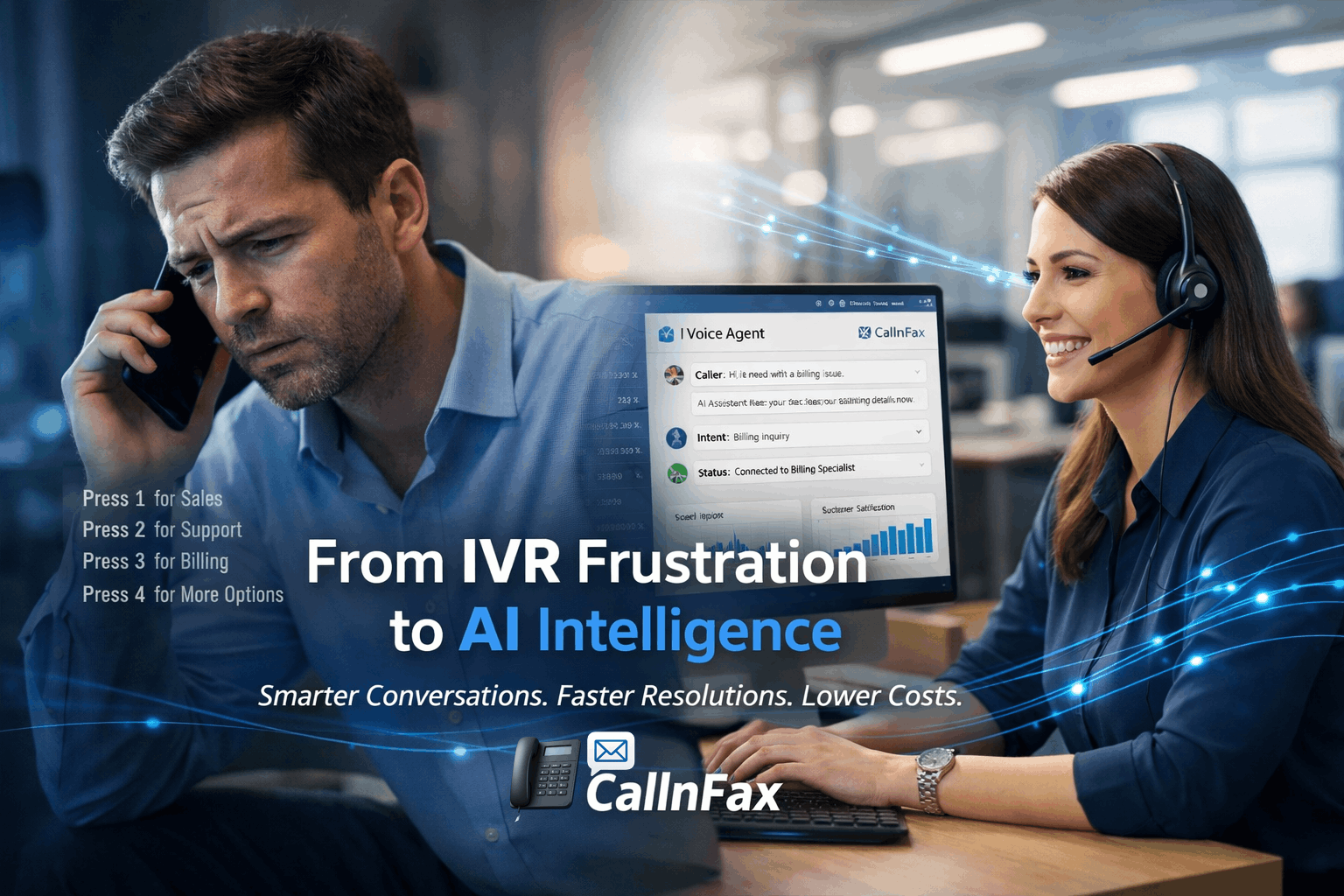
From IVR to AI Voice Agents
Turning Frustration into Productivity
About the Author: Yakov is the CTO at CallnFax
Introduction: The Evolution of Business Voice Communication
For decades, businesses have relied on phone systems to serve as the frontline of customer interaction. What began as simple receptionist-based routing evolved into automated phone trees — commonly known as IVR (Interactive Voice Response) systems. At the time, IVR felt revolutionary. It allowed companies to manage high call volumes without hiring endless support staff. Efficiency improved. Costs dropped.
But somewhere along the way, something changed.
Customers grew impatient. Menus became longer. Options became confusing. Pressing “1 for billing” often led to another maze of choices. Hold music replaced human connection. What was meant to streamline communication started to feel like a barrier.
Today, we are witnessing another transformation. AI Voice Agents — powered by advanced natural language processing and machine learning — are redefining how businesses communicate over the phone. Unlike traditional IVR systems, these agents don’t just route calls. They listen, understand, respond naturally, and adapt.
This article explores the shift:
- Why IVR systems frustrate modern customers
- Why voice recognition without intelligence falls short
- How AI Voice Agents function as intelligent representatives
- How they collect and use data effectively
- And why they ultimately reduce costs while improving customer satisfaction
The journey from IVR to AI Voice Agents isn’t just a technological upgrade. It’s a mindset shift — from automation that blocks people to automation that empowers them.
The Problem with Traditional IVR Systems
Interactive Voice Response systems were built with good intentions. They aimed to manage large call volumes, automate repetitive inquiries, and direct callers efficiently. And to be fair, they achieved part of that mission.
However, from a customer’s perspective, IVR systems often create friction instead of clarity.
1. Complex Phone Trees
Many IVR systems rely on rigid menu structures:
- Press 1 for sales
- Press 2 for support
- Press 3 for billing
- Press 4 for something else
If the caller doesn’t fit neatly into those categories, they are stuck. They may end up transferred multiple times, repeating information each time. This repetition builds frustration quickly.
Often the caller’s frustration morphs into resentment which reflects negatively on customer sentiment. Conversely, having a friendly and intelligent human answering calls works much better, but at a high cost! Enter AI Voice Agents as the solution.
2. Time Wastage
Customers today value speed. Waiting through long menu options, listening to disclaimers, or being placed on hold after navigating multiple layers feels inefficient. In some cases, a simple issue that could be resolved in two minutes turns into a 15-minute ordeal.
Time is not just money for businesses. It is emotional currency for customers.
3. Lack of Context Awareness
Traditional IVR systems operate on rules — not understanding. They don’t truly comprehend what the caller is saying. Even voice-enabled IVR systems often rely on keyword matching rather than contextual awareness.
If someone says, “I’m calling about an unexpected charge,” the system might only recognize the word “charge” and redirect the caller incorrectly.
4. Emotional Disconnect
Perhaps the biggest flaw is emotional absence. IVR systems cannot detect frustration in a caller’s tone. They cannot adjust their response style. They cannot empathize.
As customer expectations rise, this gap becomes more obvious.
Voice Recognition Without AI: A Halfway Solution
When voice recognition technology first improved, businesses attempted to modernize IVR systems by allowing callers to “say” their request instead of pressing buttons. On the surface, this seemed like progress.
However, without true artificial intelligence, voice recognition remains limited.
The Difference Between Recognition and Understanding
Voice recognition converts speech to text. It answers the question: “What words were spoken?”
Artificial intelligence answers a deeper question: “What does the caller mean?”
Without AI, systems often depend on:
- Scripted responses
- Keyword triggers
- Predefined conversational flows
This makes interactions feel robotic. The system may understand words but fail to grasp intent.
Example Scenario
Caller: “I think someone used my card without my permission.”
Non-AI voice system: Detects “card” and routes to general banking inquiries.
AI-powered system: Detects potential fraud, prioritizes urgency, and routes to fraud prevention immediately.
That difference is not minor. It can change customer trust entirely.
Why Limited Intelligence Creates Frustration
When voice recognition systems misunderstand users, callers must repeat themselves. This repetition compounds irritation and increases call duration.
In essence, voice recognition without AI is like having a receptionist who hears you clearly — but doesn’t fully understand what you’re saying.
AI Voice Agents: Intelligent, Natural Representatives for Modern Businesses
AI Voice Agents represent a fundamental shift in approach. Instead of building rigid pathways, they rely on advanced natural language understanding, contextual learning, and adaptive responses.
Companies like OpenAI, Google, and Amazon have accelerated progress in conversational AI, enabling voice systems to move beyond scripts into genuine dialogue.
What Makes AI Voice Agents Different?
- Natural Language Understanding (NLU): They interpret intent, not just keywords.
- Context Retention: They remember earlier parts of the conversation.
- Adaptive Dialogue: They respond dynamically rather than following strict trees.
- Tone Analysis: Some systems can detect urgency or frustration.
Conversational Flow Instead of Menu Trees. AI Voice Agents are commonly polyglots, allowing callers to interact in their native language, without the high cost of a multilingual answering service.
Instead of saying:
“Press 1 for billing.”
An AI Voice Agent might say:
“How can I help you today?”
Caller: “I was double-charged for my subscription.”
Agent: “I’m sorry to hear that. Let me pull up your account and check the transaction details.”
That exchange feels closer to a human interaction. The friction drops significantly.
Human-Like, But Not Human Replacement
AI Voice Agents are not designed to eliminate human representatives. Rather, they handle repetitive, predictable, or high-volume tasks so human agents can focus on complex or emotionally sensitive cases.
In practice, this means:
- Faster resolution times
- Better allocation of human talent
- Higher overall productivity
Data Collection and Intelligent Call Routing
One of the most powerful advantages of AI Voice Agents lies in their ability to collect structured data during conversations.
Real-Time Data Capture
Unlike traditional IVR systems that only record which button was pressed, AI Voice Agents can:
- Extract key entities (names, account numbers, order IDs)
- Take payment, send messages, and route calls to a department
- Identify intent categories
- Recognize recurring patterns
This data becomes actionable.
Smart Routing Based on Context
Imagine a caller says:
“I’ve called three times about this delivery delay.”
An AI Voice Agent can detect:
- Repeat call behavior
- Past interaction history
- Escalation risk
Instead of routing randomly, the system may prioritize the caller or transfer them directly to a senior agent.
Personalization at Scale
Over time, AI systems learn from aggregated interactions. This enables:
- Predictive support
- Proactive notifications
- Tailored responses
The result is not just automation — it is intelligent orchestration.
Lowering Costs While Improving Customer Sentiment
At first glance, automation may seem primarily cost-driven. And yes, AI Voice Agents do reduce operational expenses. But focusing only on cost misses the bigger picture.
- Reduced Call Handling Time
When AI systems resolve simple inquiries instantly, overall call duration drops. This reduces staffing pressure and wait times. - Lower Escalation Rates
By understanding context and routing correctly, AI Voice Agents reduce unnecessary transfers. Each avoided transfer saves time and improves satisfaction. - 24/7 Availability
Unlike human teams, AI Voice Agents operate continuously. Customers receive immediate assistance regardless of time zone. - Improved Customer Sentiment
Perhaps surprisingly, many customers prefer fast, intelligent AI interactions over poorly designed IVR systems. When the experience feels natural and efficient, trust increases.
Customer satisfaction surveys often show that what matters most is:
- Speed
- Accuracy
- Clarity
AI Voice Agents deliver on all three.
The Productivity Multiplier for Businesses
The transition from IVR to AI Voice Agents is not merely technological — it is strategic.
Businesses that adopt AI-driven voice systems gain:
- Faster onboarding for new services
- Real-time analytics dashboards
- Continuous improvement through machine learning
Operational Visibility
AI systems generate data insights that management can analyze:
- Peak call times
- Common customer issues
- Sentiment trends
- Drop-off points
These insights help optimize both customer service and broader business operations.
Scalability Without Linear Costs
Traditional growth requires hiring more staff as call volume increases. AI Voice Agents break that linear relationship. A well-designed system can handle surges without proportionally increasing costs.
This flexibility becomes especially important during seasonal spikes or product launches.
Addressing Concerns: Are AI Voice Agents Too Impersonal?
Skepticism is natural. Many people associate automation with cold, robotic interaction.
However, modern AI systems are trained to:
- Use conversational tone
- Respond empathetically
- Offer seamless handoff to humans when needed
In fact, some customers report feeling less judged when speaking to an AI system about billing issues or sensitive topics.
The key is thoughtful implementation. Poorly designed AI systems can replicate IVR frustration. Well-designed ones remove it.
Implementation Considerations for Businesses
Transitioning from IVR to AI Voice Agents requires simple planning, nothing more!
1. Define Your Use Case
Start with high-volume, repetitive inquiries:
- Route callers as needed (sales, support, accounts, etc.)
- Collect and process payments
- Appointment scheduling
- Collect data and route as needed (voice, email, text, etc.)
2. Integrate CRM and Backend Systems
Database integration allows customer identification; this enables real-time personalization.
Here’s a great example:
You own a MedSpa, and you want clients to have access to post-treatment instructions. CRM integration facilitates who gets access,
and will send an email in follow-up to the clinic and client.
3. Monitor and Optimize
AI systems improve with feedback. Regular review of interaction logs ensures continuous enhancement.
4. Maintain Human Oversight
Automation works best when supported by skilled human agents ready to step in when complexity increases.
The Future of Voice Interaction
Voice technology is evolving rapidly. As speech synthesis becomes more natural and AI reasoning capabilities improve, AI Voice Agents will feel increasingly seamless.
We are moving toward:
- Multilingual fluency
- Emotion-aware responses
- Proactive outbound communication
- Predictive issue resolution
In this landscape, the phone call is no longer a static transaction. It becomes a dynamic conversation.
Conclusion: From Frustration to Productivity
The era of rigid IVR systems is fading.
While IVR once represented innovation, today it often symbolizes inefficiency. Long menus, repeated information, and emotional disconnect no longer meet customer expectations.
AI Voice Agents represent the next stage — not just automation, but intelligence.
They:
- Understand intent
- Adapt to context
- Route intelligently
- Capture meaningful data
- Operate continuously
- Reduce costs
- Improve sentiment
Most importantly, they transform voice communication from a friction point into a productivity engine.
For businesses, this shift is not optional in the long run. Customer expectations will continue rising. Companies that cling to outdated systems risk losing trust and loyalty.
The question is no longer whether AI Voice Agents will replace IVR. The real question is how quickly businesses are willing to turn frustration into opportunity — and productivity into competitive advantage.
Interested in learning more?
Talk to us!

Comments
Post a Comment